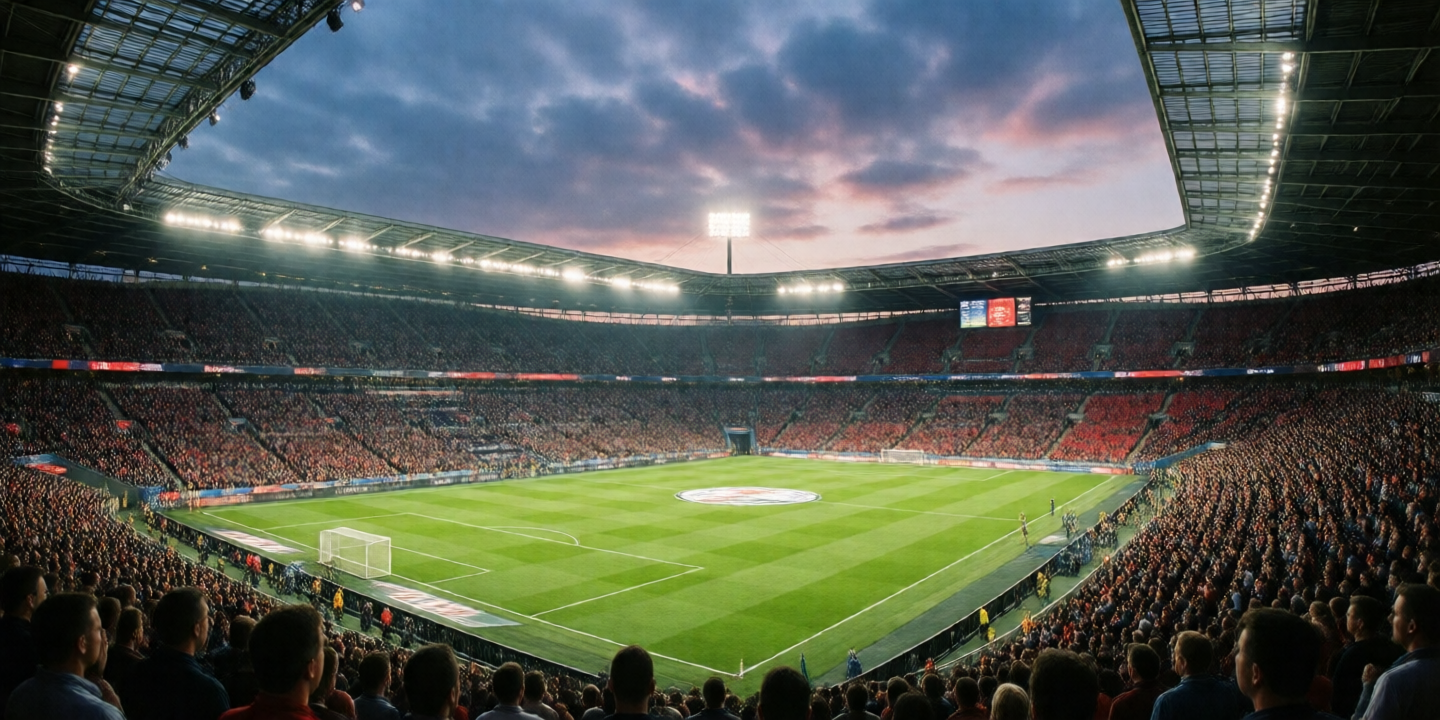
Inside FIFA World Cup 2026: A 48-Team Reality Check
The 2026 FIFA World Cup is the first men's World Cup with 48 teams, 104 matches and three host nations: the United States, Canada and Mexico. Match Daily tracks it as the biggest format change since 1998, when the field grew from 24 to 32 teams. The tournament ran from June 11 at Mexico City's Estadio Azteca to the July 19 final at MetLife Stadium in New Jersey. Twelve groups of four fed a new Round of 32, and eight of the twelve third-placed teams advanced, so two thirds of the field survived the group stage versus half in 2022. Finalists played eight matches instead of seven. Those numbers change how every market is priced. Treat the extra matches as extra variance, not extra certainty. Before staking anything on any tournament of this size, learn the third-place tiebreak math, then confirm the operator holds a valid licence.

A common misconception is: "More teams just means more of the same football." Wrong. More teams means a different tournament, with different maths. That misconception can obscure the differences between formats and betting sites. Everything should be checked twice. You should too, or am I wrong?
The Bottom Line: What Did FIFA Actually Change?
FIFA changed three things: the field grew from 32 to 48 teams, matches rose from 64 to 104, and a Round of 32 was added. Eight of twelve third-placed teams advanced, so a group-stage loss no longer ends a run. Everything else in pricing and prediction follows from that.
According to the Wikipedia entry on the FIFA World Cup, the competition has been staged every four years since the first edition in Uruguay in 1930. The 2022 edition in Qatar was the last 32-team tournament, and Argentina beat France on penalties after a 3-3 draw in the final. Data from that tournament shows 172 goals in 64 matches, or about 2.69 per game. The 2026 match count breaks down like this: 72 group games, 16 in the Round of 32, 8 in the Round of 16, 4 quarter-finals, 2 semi-finals, a third-place match and the final.
Sixteen host cities share the load: eleven in the United States, three in Mexico and two in Canada. Match Daily's reading is simple. Geography now matters as much as form. Teams in a group based around Mexico City's altitude face a different physical test than teams playing at sea level in New Jersey. Notice that I said "reading," not "guarantee." Nobody can sell you certainty here, and anyone who tries is selling something else.
What Players Actually See on a World Cup Betting Page
A World Cup betting page shows match results, outright winner prices, group winner and "to qualify" markets, and goalscorer lists, usually with a live-odds ticker. The "to qualify" prices moved most in 2026, because two thirds of teams advanced rather than half.
Open any operator's World Cup hub and you will find the same architecture. Outright winner prices sit on top, match markets (win, draw, lose, over/under goals) form the middle, and long-shot props such as golden boot fill the bottom. The front page highlights the favourites, because that is where the traffic is. The middle of the page is where value hides, and that is exactly where most newcomers never scroll. Isn't that the point of a curated page, to steer your eye?
The "to qualify" and "to reach the Round of 16" markets can change meaning between formats. In a 32-team event, a mid-ranked side in a four-team group had roughly a 50% naive chance of advancing. In 2026 that naive figure rose to 66.7%, because 32 of 48 teams advanced. A price that looked fair under old logic was suddenly too generous or too stingy, depending on which side you backed.

To see how markets differ from one another, read our beginner's guide to World Cup betting markets before your first stake. Rushing past it is how rookies get hurt.
The 3 Things That Matter Most
Three factors drove most of the format's practical impact, and they are not equally obvious. Rank them in this order when you analyse any match or market:
- The third-place ladder. Eight of twelve third-placed teams advance, ranked across groups.
- The eighth match. Finalists play eight games, and every qualifier needs five knockout wins to lift the trophy.
- Travel and climate. Sixteen venues across three countries stretch logistics far more than Qatar's compact eight stadiums did.
Start with the ladder. Because third-placed teams are compared across groups, a team's fate can depend on results in groups it never plays against. FIFA's published regulations set the ranking order, led by points, then goal difference and goals scored. Goal difference now matters even in a dead-rubber third game. A 1-0 loss is far less costly than a 4-0 loss, and a team that knows this will protect its numbers rather than gamble.
Next comes the eighth match. Under the old format, a group winner needed four knockout wins. Now every qualifying side needs five, and that is a real fatigue cost. Squads with deep benches gain, and squads built around eleven stars lose. Match Daily's own team-tactics coverage treats squad depth as a first-order variable for exactly this reason. Finally, travel. A team that spends the group stage in one region and then flies across a continent for the Round of 32 pays a recovery tax. Read our team tactics and squad depth breakdowns to see which squads were built for that.

Edge Cases & Gotchas: Where Do Bettors Get Burned?
Bettors get burned by third-place math, extra-match fatigue and lookalike betting sites. A team can lose a group game and still advance, a finalist plays eight games, and scam domains multiply during major tournaments. Check each point before staking; none is obvious from the odds screen alone.
Here is the first insight that most top-ranking articles skip. The goal tally of a World Cup scales with match count, but not necessarily with quality. At 2022's rate of 2.69 goals per match, 104 games would produce about 280 goals, against 172 in Qatar. That is simple arithmetic, not a forecast. Weaker qualifiers could push scoring up in lopsided matches, so total-goals lines deserve fresh scrutiny rather than copy-pasted assumptions from 2022.
The second insight concerns timing. Final group matches in each group kick off at the same time, but the twelve groups are staggered across days. A team in an early-finishing group sets a third-place total that later groups can read. Bettors who watch for that, and check the ladder before staking on a late-group "to qualify" market, hold information the headline price may not reflect yet. It is a small edge, and it is only an edge if you do the homework.
Now the unglamorous part. Major tournaments attract copycat domains. Verify the licence number on the regulator's own website, not the footer of the betting site. Check that the domain matches the licensed operator's. Never deposit through a payment method that the site pushes on you in chat. That is why checking the licence matters. Per the National Council on Problem Gambling, help is available if betting stops being fun, and you should set limits before you start, not after you lose.
Confirm the licence on the regulator's register.
Set a deposit limit before the first match.
Never chase a loss with a bigger stake.
Verdict
The 48-team World Cup is bigger, longer and softer at the bottom, and its biggest effect is on advancement odds, not on the trophy. A naive 66.7% qualification rate, a mandatory fifth knockout win and a third-place ladder that crosses groups are the facts that matter. Everything else is noise, or marketing.
Match Daily's advice is the same I would give any apprentice who never listens: study the format before the teams. Learn how the ladder works. Treat total-goals lines with suspicion until the data catches up. Keep your stakes small enough that a bad weekend is an annoyance, not a crisis. For deeper reading, our player stats and tournament coverage hub and the official FIFA website are good places to cross-check everything above. Cross-checking is the whole point, isn't it?
The football itself was always the easy part. What separates calm fans from burned ones is preparation, and preparation costs nothing but an evening.

Frequently Asked Questions
Q: What is the FIFA World Cup 2026 format?
A: It is a 48-team tournament with 12 groups of four, followed by a Round of 32. The top two in each group plus the eight best third-placed teams advance, giving 32 knockout teams. The event covers 104 matches across 16 cities in the United States, Canada and Mexico, and it ended with the final on July 19, 2026 at MetLife Stadium.
Q: How do the eight best third-placed teams get chosen?
A: They are ranked across all twelve groups using a points table. Points come first, followed by goal difference and goals scored, with further tiebreakers in FIFA's official regulations. Check the published rules for the exact sequence, because the order matters when two teams finish level. Because each group plays out on different days, later groups can see the benchmark total before their last match.
Q: Is a 48-team World Cup better than a 32-team one?
A: It depends on what you value, but it is clearly different. More teams means more matches (104 versus 64) and a softer group stage, since two thirds of teams advance instead of half. The trade-off is more mismatches early and a longer road for finalists, who play eight games. Fans of underdogs gain, and fans of tight group drama may lose.
Q: How can I check that a World Cup betting site is legitimate?
A: Look up the licence number on the regulator's own public register, not on the betting site's footer. Confirm that the domain and company name match the licence holder exactly. Warning signs include pressure to deposit through chat, bonuses that look too good to be true, and a missing withdrawal policy. If any one of these shows up, walk away before depositing.
Q: Why do "to qualify" odds look different from past World Cups?
A: They look different because the base rate rose from 50% to 66.7%. When 32 of 48 teams advance, even weaker sides become likelier to survive the group, so fair prices for qualification shorten across the board. If a price still looks like a 32-team price, either the operator is slow to adjust or you are misreading the format.
Q: How much does it cost to follow World Cup coverage and predictions?
A: Following coverage on Match Daily and the official FIFA site is free, and you need no stake to read predictions. Betting is optional and carries real financial risk, so set a fixed budget you can afford to lose, such as a weekly limit, before placing any wager. If gambling stops feeling like entertainment, contact a support organisation in your country.